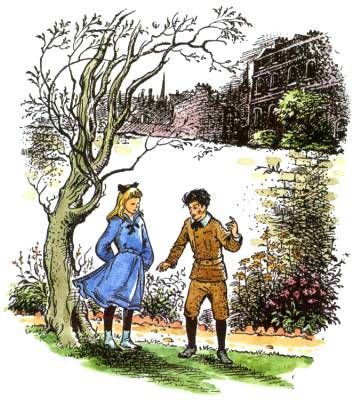
If you’ve read the Chronicles of Narnia, you probably remember the Narrator’s voice. The Narrator does far more than tell a story — he or she walks you through the adventures scene by scene. The Narrator is emotionally present and his or her personality permeates the entire story. The Narrator often speaks directly to the audience:
I hope no one who reads this book has been quite as miserable as Susan and Lucy were that night; but if you have been—if you’ve been up all night and cried till you have no more tears left in you—you will know that there comes in the end a sort of quietness.
– The Lion, the Witch and the Wardrobe
Chapter Fifteen: Deeper Magic from Before the Dawn of Time
The Narrator holds and expresses personal opinions:
Consequently, when the Pevensie children had returned to Narnia last time for their second visit, it was (for the Narnians) as if King Arthur came back to Britain, as some people say he will. And I say the sooner the better.
– The Voyage of the Dawn Treader
Chapter One: The Picture in the Bedroom
Who is the Narrator of Narnia?
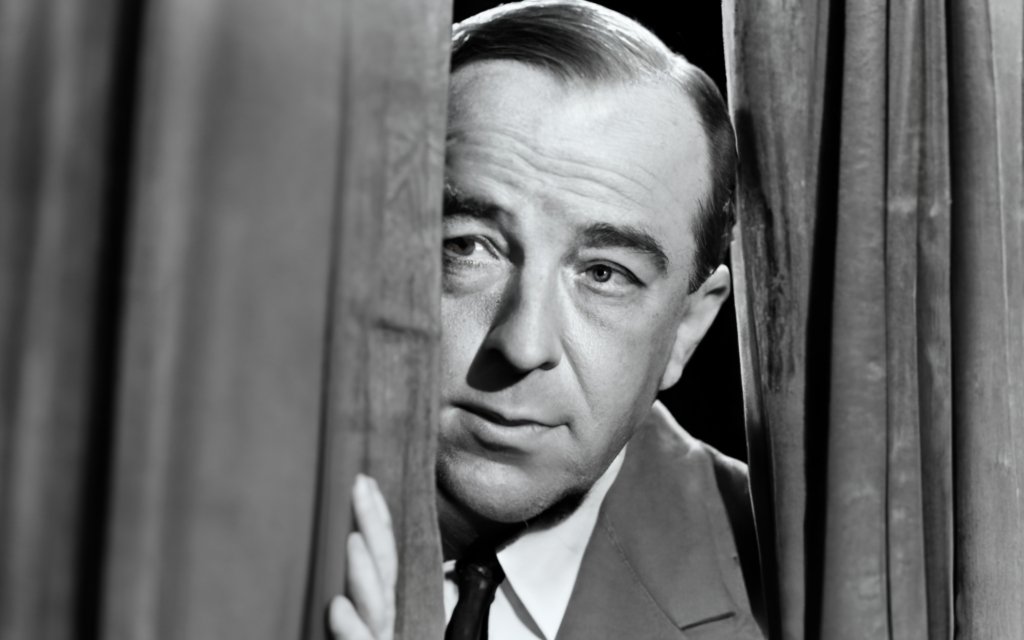
Some people theorize that the Narrator is Lucy or Digory. Most often, the Narrator is described as Anonymous, and the style is called third-person omniscient. Personally, I’ve always pictured C.S. Lewis himself peeking out from behind the curtain.
But late last night while moving some boxes in a storage unit and listening to Kenneth Brannan’s brilliant audio performance of “The Magician’s Nephew”, I started to wonder: could the Narrator be Polly Plummer? For me, the hat fits no one else as well. So suspend disbelief for a moment. Here are some clues to consider:
The Narrator is not omniscient
Contrary to popular opinion and the current consensus, the Narrator does not know quite everything. The Narrator has talked to the Pevensies, Eustace, and Jill after their returns from Narnia and acts as a historian who seems to perform research.
“I’ve never understood why they belong to Narnia,” said Caspian. “Did Peter the High King conquer them?”
“Oh, no,” said Edmund. “They were Narnian before our time—in the days of the White Witch.”
(By the way, I have never yet heard how these remote islands became attached to the crown of Narnia; if I ever do, and if the story is at all interesting, I may put it in some other book*.)
– The Voyage of the Dawn Treader
Chapter Three: The Lone Islands
*The Narrator eventually conveys this story (regarding King Gale and a dragon) a few years later in The Last Battle, Ch. 8.
The Narrator may need to estimate:
His name was King Tirian, and he was between twenty and twenty-five years old; his shoulders were already broad and strong and his limbs full of hard muscle, but his beard was still scanty.
– The Last Battle
Chapter Two: The Rashness of the King
The Narrator is not Lucy,
but knows Lucy personally
And suddenly there came a breeze from the east, tossing the top of the wave into foamy shapes and ruffling the smooth water all round them. It lasted only a second or so but what it brought them in that second none of those three children will ever forget. It brought both a smell and a sound, a musical sound. Edmund and Eustace would never talk about it afterward. Lucy could only say, “It would break your heart.”
“Why,” said I, “was it so sad?”
“Sad!! No,” said Lucy.
– The Voyage of the Dawn Treader
Chapter Sixteen: The Very End of the World
The Narrator is not Digory
Given the context of the Polly and Digory’s adventure with Jadis in the Wood Between the Worlds, this truly sounds like Polly’s voice:
I think (and Digory thinks too) that her mind was of a sort which cannot remember that quiet place at all, and however often you took her there and however long you left her there, she would still know nothing about it.
– The Magician’s Nephew
Chapter Six: The Beginning of Uncle Andrew’s Troubles
The Narrator knows England
(as well as Narnia)
(Giants of any sort are now so rare in England and so few giants are good-tempered that ten to one you have never seen a giant when his face is beaming. It’s a sight well worth looking at.)
– The Lion, the Witch and the Wardrobe
Chapter Sixteen: What Happened About the Statues
She stood as still as if she had been turned into stone, with her mouth wide open. And she had a very good reason; just on this side of the stream lay the lion.
It lay with its head raised and its two fore-paws out in front of it, like the lions in Trafalgar Square.
– The Silver Chair
Chapter Two: Jill Is Given a Task
They came out on one of those rough roads (we should hardly call them roads at all in England) which ran through Lantern Waste.
– The Last Battle
Chapter Six: A Good Night’s Work
The Narrator seems to know Polly’s
thoughts better than Digory’s
“I’m game if you are,” said Polly. But she really said this because, in her heart of hearts, she now felt sure that neither kind of ring was going to work at all in the new pool, and so there was nothing worse to be afraid of than another splash. I am not quite sure that Digory had not the same feeling.
– The Magician’s Nephew
Chapter Three: The Wood Between the Worlds
The Narrator remembers life in 1900
(when Mr. Lewis would have been one or two years old)
But meals were nicer; and as for sweets, I won’t tell you how cheap and good they were, because it would only make your mouth water in vain.
– The Magician’s Nephew
Chapter One: The Wrong Door
Chronologically, the very first person
mentioned in the series is Polly
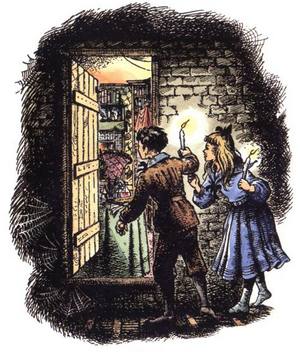
And in those days there lived in London a girl called Polly Plummer.
– The Magician’s Nephew
Chapter 1: The Wrong Door
Polly is mentioned in the
last chapter of the series
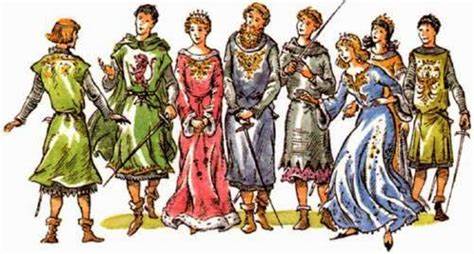
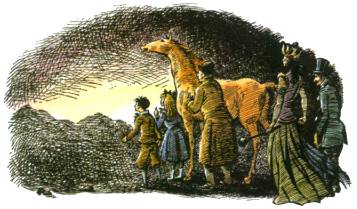
But next moment he had something else to think of, for out of the gateway there came a horse so mighty and noble that even a Unicorn might feel shy in its presence: a great winged horse. It looked a moment at the Lord Digory and the Lady Polly and neighed out, “What, cousins!” and they both shouted “Fledge! Good old Fledge!” and rushed to kiss it.
– The Last Battle
Chapter Sixteen: Farwell to Shadowlands
The Narrator seems to have tasted
the fruit in Aslan’s world
What was the fruit like? Unfortunately no one can describe a taste. All I can say is that, compared with those fruits, the freshest grapefruit you’ve ever eaten was dull, and the juiciest orange was dry, and the most melting pear was hard and woody, and the sweetest wild strawberry was sour. And there were no seeds or stones, and no wasps. If you had once eaten that fruit, all the nicest things in this world would taste like medicines after it. But I can’t describe it. You can’t find out what it is like unless you can get to that country and taste it for yourself.
– The Last Battle
Chapter Thirteen: How the Dwarves Refused to Be Taken In
Polly is the only writer
mentioned in the series
Polly had used the bit of the tunnel just beside the cistern as a smugglers’ cave. She had brought up bits of old packing cases and the seats of broken kitchen chairs, and things of that sort, and spread them across from rafter to rafter so as to make a bit of floor. Here she kept a cash-box containing various treasures, and a story she was writing and usually a few apples. She had often drunk a quiet bottle of ginger-beer in there: the old bottles made it look more like a smugglers’ cave. Digory quite liked the cave (she wouldn’t let him see the story) but he was more interested in exploring.
– The Magician’s Nephew
Chapter 1: The Wrong Door
Of course, this is just a fan theory. In the publication order, Polly is not introduced until the sixth book. But, for me, no one else fits the Narrator role so well. Polly begins and ends the timeline, she knows Narnia and she knows England; Polly personally knows Digory, Lucy, Edmond, Peter, Susan, Eustace, and Jill; and finally, she is the only character in the series who is a writer. Who could chronicle Narnia better than a writer who observed Narnia on the day of its birth and on the day of its death?
Mr. Lewis let us know that Polly was writing a story. Was that a random tangent? I wonder, did Polly keep writing? If so, what did Polly write?
 The Elements of Simple
A great case well made! You clenched it for me with the tiny detail that she was writing a story. ________________________________
LikeLiked by 1 person