
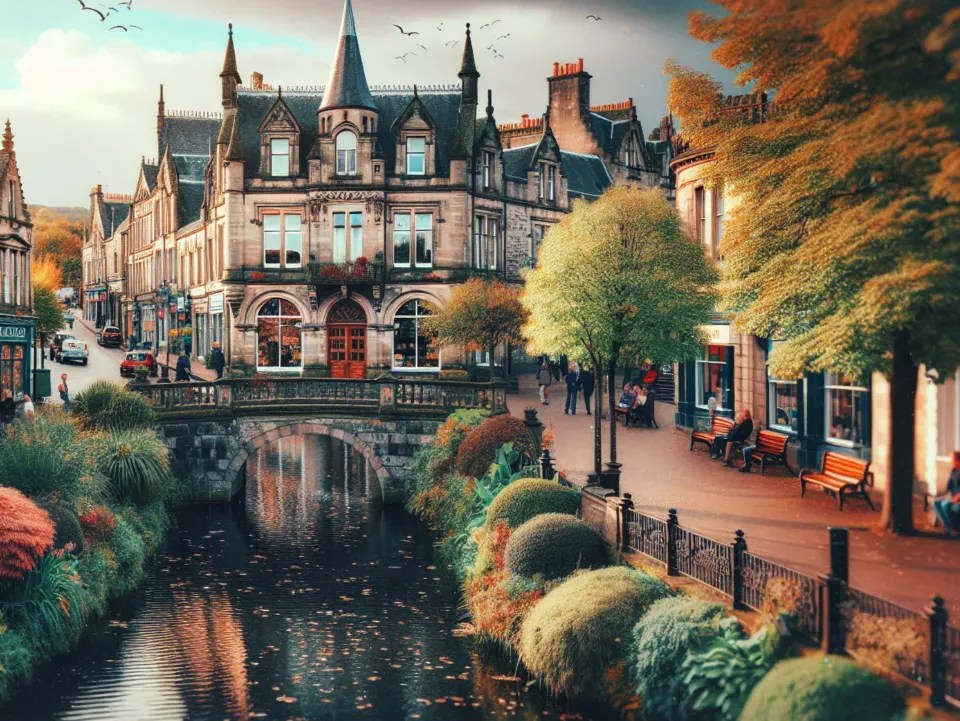
A buddy in the UK posted this picture with the message:
My Outlook AI-generated theme today. Where does the river go to beyond the bridge, or is this just a flooded road?
Thinking that it might be funny, I asked another AI (Claude) to tell me the story of this picture. The resulting story was so much better than I expected:
In the village of Bridgemoor, there stood a peculiar building that no architect could claim and no historian could date. The Grand Teahouse, as locals called it, sat astride the River Whisper like a satisfied cat—its ornate turrets piercing the autumn sky while the dark waters flowed directly beneath its foundation.
Old Margaret, who ran the establishment, would tell visitors that the building hadn’t always been this way. “No, no,” she’d say, pouring amber tea into delicate china cups. “Once upon a time, it sat properly on the north bank, as respectable buildings do.”
But the river, it seemed, had other ideas.
It began the year the famous architect Cornelius Blackwood designed the teahouse with such pride that he declared it “immovable as the stars themselves.” The River Whisper, which had been quietly flowing its course for a thousand years, took this as a personal challenge.
That very night, the river began to shift. Not all at once—that would have been too obvious. Just an inch here, a foot there, slowly carving a new channel. By the time anyone noticed, the water had split itself in two, curving around either side of the building’s foundation like liquid fingers reaching toward each other.
“Should we do something?” the mayor had asked, watching the phenomenon with alarm.
“About a building that won’t move or a river that won’t stop?” Old Margaret had replied. She was young Margaret then. “I say we see who wins.”
Neither did. Instead, they reached an agreement.
The river flowed beneath the teahouse through three stone archways that had certainly not been part of the original design but appeared nonetheless—smooth and ancient as if they’d been there since the dawn of time. The building settled more comfortably into its new position, its reflection now dancing in the water below, its doors now opening onto both sides of the river via the little stone bridge.
Some say on quiet autumn evenings, when the leaves turn copper and gold, you can sit in the teahouse and hear two sounds: the gentle gurgle of water far below your feet, and the satisfied humming of a building that refused to budge while a river ran its course around it.
Margaret still serves tea there, much older now, and when tourists photograph the impossible architecture with puzzled expressions, she simply smiles and says, “Sometimes the world rearranges itself around stubbornness. Best to just enjoy the view.”
And truly, there was no better view in all of Bridgemoor—a village where rivers knew their own minds, and buildings stood their ground, and somehow, impossibly, both got their way.
 The Elements of Simple
[…] …(more) […]
LikeLike